


 (214) 383-0954

 Book Online
 The Question Most Frisco Families Wait to Ask
Here’s something we hear often at Price Family Orthodontics: a parent brings in their child for a first evaluation, we spend time together going over everything we see, and somewhere in that conversation they say, “I really wish we had come in sooner.”
It’s not a criticism of anyone. Orthodontic timing is genuinely confusing, and most families don’t have a clear roadmap. You’re not sure whether what you’re noticing in your child’s mouth is something to act on. You’re not sure if baby teeth need to come out before anything else happens. You’re not sure if your child is old enough for braces yet, or whether the spacing issue you’ve been watching for months is actually a problem or just how things look for now. So you wait. That’s completely understandable.
What most families don’t realize is that an orthodontic evaluation is not a commitment to start treatment. It’s a conversation. It gives you real information from a specialist about what’s actually happening with your child’s smile and what, if anything, needs to happen next. That information has real value regardless of the answer.
If you’ve been searching for a child orthodontist in Frisco, TX or asking yourself when your child should see an orthodontist in Frisco, or whether it’s too late to pursue treatment as an adult, this guide was written for you. We cover everything: the signs to watch for, how the most common treatments compare, what to expect when you walk through our door, and how to choose an orthodontist in Frisco who will genuinely take the time to get it right.
What Does an Orthodontist Actually Do?
This is worth explaining because a lot of families assume that orthodontists and general dentists offer the same thing when it comes to braces and alignment. They don’t.
An orthodontist is a specialist. After completing dental school, an orthodontist goes on to spend two to three additional years in a specialized training program focused entirely on how teeth move, how jaws develop, and how to diagnose and correct alignment problems. That training is the difference between a provider who offers orthodontics as one of many services and a provider whose entire focus is the smile in front of them.
Dr. Brandon Price completed that specialized training at the University of Colorado, on top of his dental degree from the University of Louisville. He stays current through continuing education every year, not just to maintain a license, but because he genuinely enjoys learning and believes it makes him a better doctor for his patients.
What that training addresses goes well beyond straight teeth. Good alignment affects how you bite and chew, how your teeth wear over time, how your jaw functions, and how easy it is to keep your teeth clean. When everything lines up properly, brushing and flossing work better, which supports your long-term dental health in ways that go beyond how your smile looks. A great smile is a wonderful outcome of orthodontic treatment, but it’s built on a foundation of function first.
Signs Your Child May Need Orthodontic Care
You don’t need a referral from your child’s dentist to schedule an evaluation. Many families in Frisco, McKinney, Prosper, and the surrounding North Texas area come in simply because they noticed something and want to understand what they’re looking at. That is exactly the right instinct.
Here are some of the more common signs that suggest a check-in with an orthodontist may be helpful:
- Crowded or overlapping teeth: When baby teeth look cramped in the mouth, permanent teeth often have even less room to come in properly. Catching this early gives the orthodontist more options to work with.
- Gaps between teeth: Spacing issues can affect both how the teeth function and how they align over time. Some gaps signal a size mismatch between the teeth and jaw that benefits from earlier attention.
- Difficulty biting or chewing: If your child tends to avoid certain foods, bites the inside of their cheek regularly, or mentions that chewing is uncomfortable, the way their teeth come together may be the reason.
- Mouth breathing: Children who breathe primarily through their mouth, especially while sleeping, can sometimes have jaw development patterns that benefit from early evaluation.
- Baby teeth falling out much earlier or later than expected: When baby teeth don’t follow a typical timeline, the path for permanent teeth can be disrupted in ways worth having a specialist look at.
- Upper front teeth that stick out noticeably: Front teeth that protrude are more vulnerable to chipping or injury during play, and they are often easier to address while a child is still growing.
- An obvious overbite, underbite, or crossbite: When the upper and lower teeth don’t come together the way they should, that bite relationship often responds better to treatment during childhood than it does later.
- Jaw sounds or soreness: Clicking or popping in the jaw, or persistent jaw discomfort, can be worth mentioning to an orthodontic specialist.
A quick note here: coming in with a concern and being told “there’s nothing to do yet, let’s check back in six months” is not a wasted visit. That answer replaces uncertainty with a clear plan.
What Age Should My Child First See an Orthodontist?
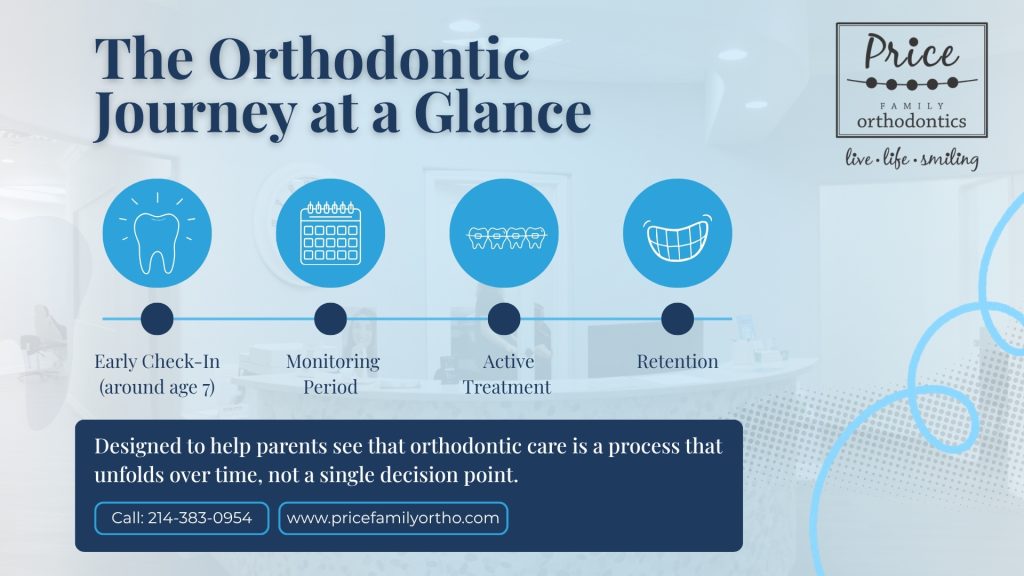
The country’s leading orthodontic organization recommends that children have their first orthodontic evaluation by around age seven. That recommendation surprises a lot of parents, especially if their child still has plenty of baby teeth.
The reason for that early check-in is not to start treatment at seven. It’s to get a clear picture of what’s happening while a child is still in that window where both baby teeth and adult teeth are present. At that stage, a trained orthodontist can see how the permanent teeth are coming in, assess whether there’s enough room for them, and evaluate how the upper and lower jaws are growing relative to each other. Issues that are caught here often require less intervention later, because there’s still time to guide development rather than correct it after the fact.
When families ask Dr. Price what the best age for braces is, his answer is always the same: it depends on the individual child. Some benefit from a first round of treatment as young as seven or eight, particularly when there’s a jaw issue that responds better to early correction. Many more are best served by monitoring through the years when adult teeth are coming in and beginning full treatment in early adolescence, typically around eleven to thirteen. And some children come in for an evaluation and simply need to be seen again down the road.
The value of that early conversation is not that it triggers a plan. It’s that it puts your family in the hands of someone who knows what to watch for, so that when the time is right, you’re ready to move forward with confidence.
Adult Orthodontics in Frisco: It Is Not Too Late
One of the most persistent myths about orthodontic care is that it’s something you either did as a kid or missed your chance at. That’s not true. A significant and growing number of orthodontic patients today are adults, and the results they achieve are real.
People come in for adult orthodontic treatment for all kinds of reasons. Some had braces when they were younger but didn’t wear their retainer consistently, and their teeth have shifted back over time. Some never had the opportunity for treatment growing up. Some are dealing with bite issues that have been causing teeth to wear down gradually, or jaw discomfort that has built up over years. And some simply want to feel good about their smile and are ready to do something about it.
The process works the same way it does for younger patients. Teeth respond to the gradual, gentle pressure that braces and clear aligners apply throughout adulthood, which is why treatment is effective at any age. The main practical difference is that adult bone is fully developed, so some cases that could have been addressed more simply during childhood may take a different approach or a somewhat longer timeline. But many adults complete treatment in a timeframe similar to what teenagers experience.
For adults trying to decide between Invisalign and braces in Frisco, the right choice depends on the specific case. Invisalign is a strong option for many adults, particularly those with mild to moderate crowding or spacing, or those who want a discreet option that fits a professional routine. Traditional braces or clear ceramic braces are often the better clinical choice for more complex cases. Dr. Price will walk through both options honestly at your consultation, based on what your smile actually needs, not on what’s easiest to offer.
Invisalign vs. Braces: A Plain-Language Comparison
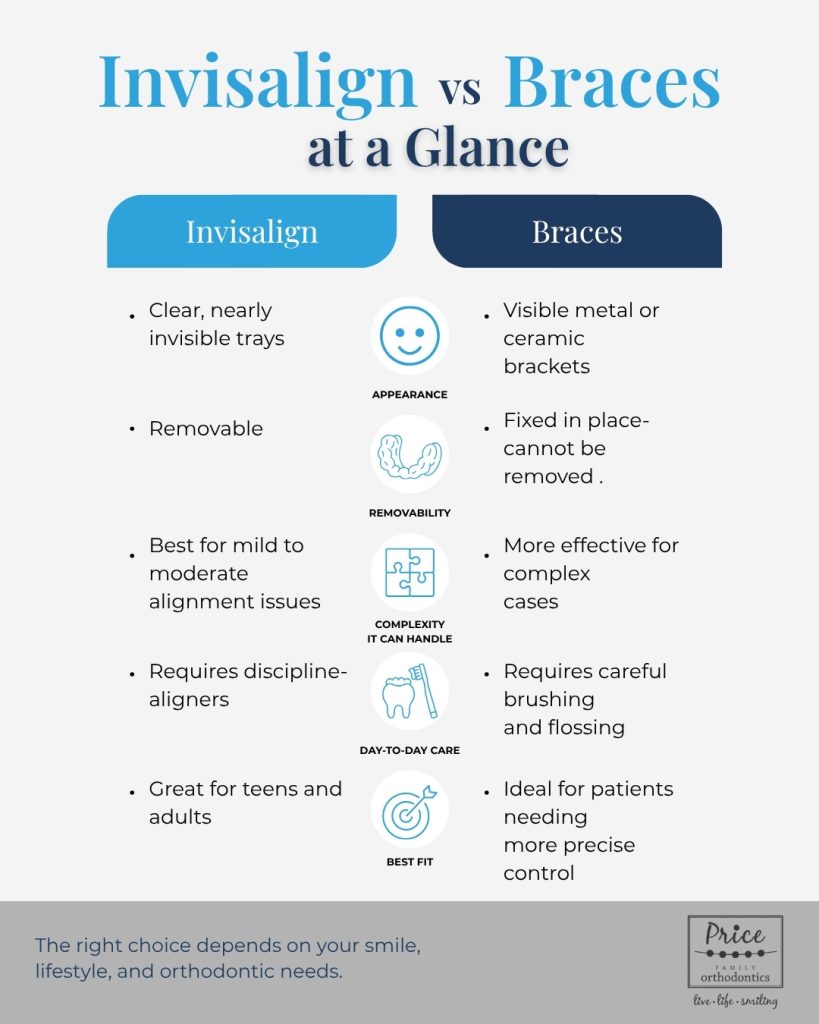
If you’re trying to figure out whether Invisalign or braces makes more sense for you or your child, you are asking one of the most common questions that comes up in first consultations. The honest answer is that neither is always better. The right choice depends entirely on the specific situation.
Traditional Braces
- How they work: Brackets are bonded to the teeth and connected by a wire that is adjusted throughout treatment to guide teeth into the right position. The wire does the work gradually, over a series of appointments.
- Best suited for: A wide range of situations, including more complex bite corrections, significant crowding, and cases where very precise tooth movement matters. Braces give the orthodontist a high level of control.
- Your options: At Price Family Orthodontics, patients can choose traditional metal brackets or clear ceramic brackets for a less noticeable look while still benefiting from fixed treatment.
- Day to day: Braces stay on throughout treatment, so certain foods should be avoided and brushing takes a bit more care. Most patients adjust quickly and find it very manageable.
- How long: Treatment time varies based on the complexity of the case. Some finish in about a year. More involved cases may take closer to two years or a bit longer.
Invisalign
- How it works: A series of custom-made clear trays are worn over the teeth and swapped out every week or two. Each set of trays moves the teeth a small amount, and over time those small movements add up to a straighter smile.
- Best suited for: Mild to moderate crowding and spacing, and many bite situations. Invisalign’s technology has improved a lot in recent years and can now handle a wider range of cases than it used to.
- What it looks like: The trays are clear and fit closely against the teeth. For most people they are not noticeable in conversation or in photos.
- Day to day: You take the trays out to eat and drink anything other than water, and to brush your teeth. The trays need to be in for around 20 to 22 hours a day for treatment to stay on track, so consistency matters.
- Who it suits well: Adults and older teens who want a more discreet option and are confident they will wear the trays consistently. Compliance is the most important variable with Invisalign.
The bottom line: clear aligners can be just as effective as braces for the right case. The key is working with an orthodontist who evaluates your specific situation and recommends what will actually produce the best result for you, not just the most convenient one to offer.
How to Choose an Orthodontist in Frisco TX
Choosing an orthodontist in North Texas is a bigger decision than it might feel like at first. You aren’t just picking a provider for a transaction. You’re choosing someone who will be involved in your or your child’s care for a year or more, making clinical decisions that affect outcomes your family lives with for a long time.
Here are the questions worth asking before you commit:
- Is the provider a trained orthodontic specialist? Orthodontists complete additional years of specialized training after dental school, focused entirely on tooth movement and jaw development. That expertise matters and is worth confirming.
- Will you see the same doctor at every appointment? At some practices, the orthodontist checks in briefly and the majority of clinical work is done by assistants. At Price Family Orthodontics, Dr. Price is present and involved at every visit.
- What does the consultation actually look like? A consultation that moves quickly from the exam straight to a treatment proposal, without much back-and-forth, is worth paying attention to. A genuinely patient-first consultation feels more like a conversation than a sales process.
- What is the practice’s approach to treatment recommendations? Does the orthodontist recommend only what the evidence supports, or does every patient seem to need the same thing? A good orthodontist should be able to explain their reasoning clearly and be willing to discuss alternatives.
- How long has the practice been part of this community? Consistency and local reputation over time tend to reflect the quality of the experience patients actually have.
- What do real patients say? Reviews from families you trust are among the most reliable ways to get a genuine sense of a practice before your first visit.
The difference between a large, corporate orthodontic practice and a private, doctor-led practice like Price Family Orthodontics is not always obvious from the outside. It tends to become very clear once you’re in the chair, in how your questions are answered, in who is making the decisions about your care, and in how you feel walking out of every appointment.
What to Expect at Your First Consultation at Price Family Orthodontics
A lot of families hold off on scheduling because they are not sure what a consultation actually involves, or because they are worried about being pushed toward a decision before they are ready. Here is exactly what happens when you come in to see Dr. Price:
- A warm welcome. From the moment you arrive, the team works to make sure you and your family feel comfortable and at ease. There is no pressure here, and the energy in the office reflects that.
- A thorough look at your teeth, bite, and jaw. Dr. Price examines how your teeth are aligned, how your upper and lower teeth come together when you bite, and how your jaw is sitting. He looks at what is happening now and what he expects to see develop over time.
- X-rays or photos if needed. Depending on your situation, a few images may be taken to give Dr. Price a complete and accurate picture before he makes any recommendations.
- A clear explanation of what he finds. This is where Price Family Orthodontics consistently stands apart. Dr. Price walks through what he sees in plain language, explains what it means for your specific situation, and answers every question you have. Nothing gets glossed over.
- An honest conversation about your options. Whether the recommendation is to start treatment now, monitor for a while, or explore a particular approach, you will leave understanding your path forward and the reasoning behind it.
- Next steps entirely on your timeline. There is no obligation to schedule treatment at your consultation. The goal of the appointment is to make sure you leave more informed than when you walked in.
A good orthodontic treatment plan should include a clear explanation of the diagnosis, the reasoning behind the recommended approach, a realistic timeline, transparent information about costs and payment options, and a plan for checking in on progress throughout treatment. If you have had a consultation elsewhere and any of those pieces were missing, it may be worth getting a second opinion.
Why Personalized Orthodontic Care Produces Better Outcomes
Personalized orthodontic care is not just a phrase that sounds good. It describes a fundamentally different way of making treatment decisions and a fundamentally different experience for patients.
In a high-volume practice, the model is built around seeing as many patients as possible efficiently. Treatment plans tend to follow familiar patterns. The person making clinical decisions may rotate between providers. None of that is necessarily the result of bad intentions, but it does mean that the subtle details of an individual case can get lost in the throughput.
In a doctor-led, personalized practice like Price Family Orthodontics, the individual case drives every decision. The same doctor who evaluated you is the one overseeing your care at every subsequent appointment. Treatment plans are built from scratch for each patient, based on their specific situation, their goals, and their day-to-day life. When you have a question, you get a real answer from someone who knows your case.
Is that kind of care worth seeking out? The patients at Price Family Orthodontics consistently say yes. Not because the technology is different, but because feeling genuinely known by your provider changes how you experience treatment. You understand what is happening and why. You trust the plan because it was built around you, not around a standard protocol. And when you finish treatment, you know the outcome reflects the care that went into it.
Dr. Price stays current by attending continuing education courses and seminars every year. He does this because he genuinely enjoys learning and because it makes him a better doctor. That commitment to growing his expertise is ultimately an investment in the quality of care every one of his patients receives.
Serving Frisco, McKinney, Prosper, and Surrounding Communities
Price Family Orthodontics is located at 5520 Independence Parkway, Suite 200, in Frisco, TX 75035. We provide orthodontic care for children, teens, and adults throughout Frisco and nearby North Texas communities, including McKinney, Prosper, Plano, Allen, Little Elm, The Colony, and surrounding areas.
If you have been looking for a trusted orthodontist in Frisco TX, a family orthodontist near McKinney, or an Invisalign provider in Prosper, Price Family Orthodontics is within reach. We welcome new patients, families transferring from other practices, and anyone who would like a second opinion before committing to a treatment plan.
Our office is open Monday, 9:00 AM to 5:00 PM and Tuesday through Friday 8:30 AM to 5:00 PM. You can schedule a consultation by calling 214-383-0954 or through our website at pricefamilyortho.com.
Ready to Take the Next Step?
If you’ve been thinking about scheduling a consultation for your child, your teenager, or yourself, this is a good moment to do it. You do not need to have everything figured out before you come in. You just need to show up and ask your questions. We will take it from there.
At Price Family Orthodontics, every consultation is a real conversation. Dr. Price will take the time to understand your situation, walk you through your options in plain language, and answer every question you have before any decision is made. There is no pressure and no rush.
We serve families throughout Frisco, McKinney, Prosper, Plano, Allen, Little Elm, The Colony, and surrounding communities across North Texas. We would love the opportunity to help your family smile with confidence.
Call or visit us anytime: 214-383-0954 | 5520 Independence Parkway STE 200, Frisco, TX 75035